Shadows and the Embedded Perspective

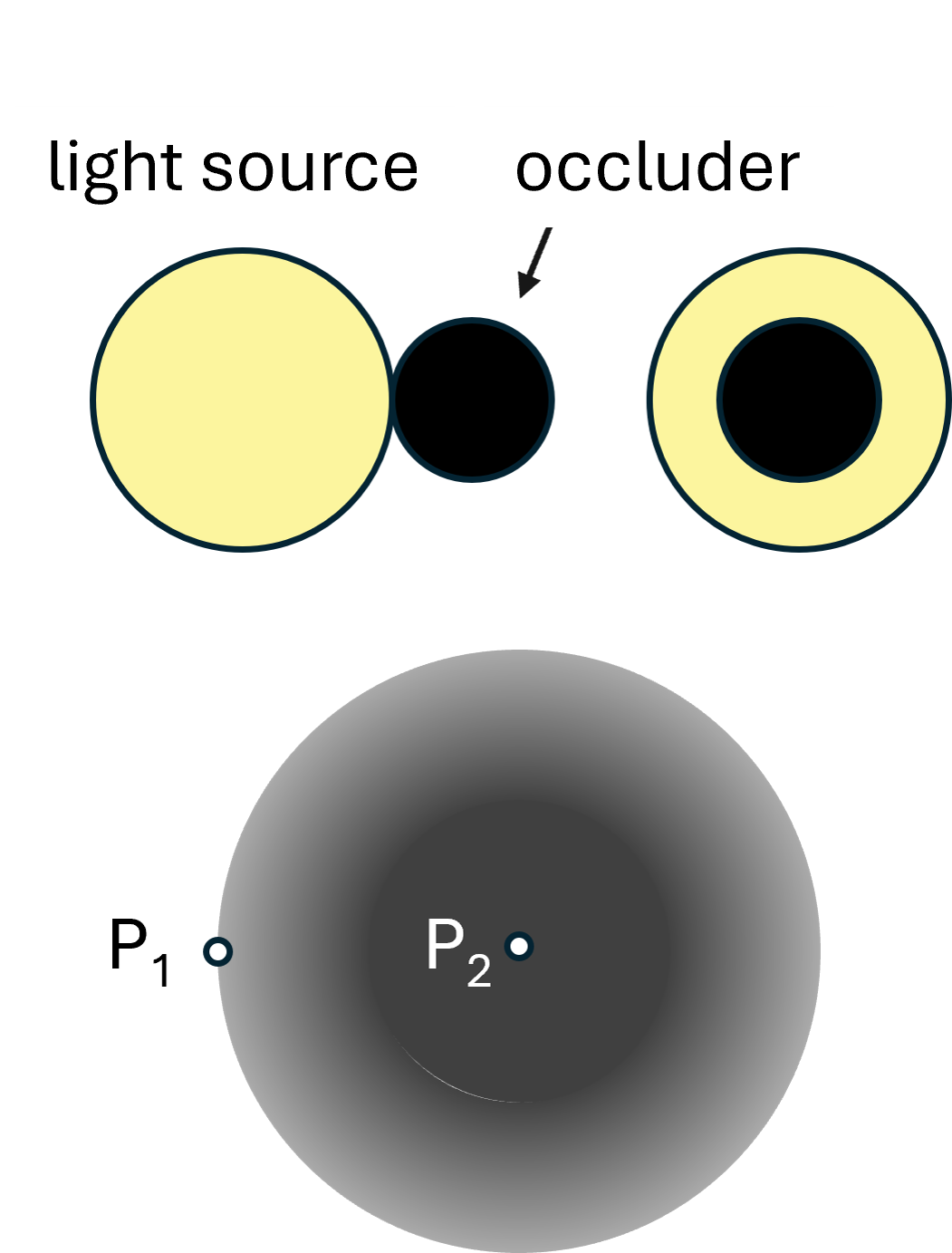
In optics education, shadows are often regarded as simple phenomena—mere silhouettes of objects that block light. A closer look, however, reveals that shadow images are far more fascinating and complex. Shadow phenomena become particularly transparent when viewed from a new point of view: the so-called embedded perspective. From this perspective, it becomes clear how strongly both the shape of the object and the nature and position of the light source influence the appearance of a shadow. With simple experiments, a deeper understanding of these remarkable phenomena can be achieved. Along the way, one may even encounter unexpected effects—such as the so-called “bright shadow.”
Contributions to a phenomenological theory of shadows
-
Grebe-Ellis, J. & Quick, T. (2023): Soft Shadow Images, European Journal of Physics 4/44: 1–23
Abstract: In traditional optics education, shadows are often regarded as a mere triviality, namely as silhouettes of obstacles to the propagation of light. However, by examining a series of shadow phenomena from an embedded perspective, we challenge this view and demonstrate how, in general, both the shape of the object and the light source have a significant impact on the resulting soft shadow images. Through experimental and mathematical analysis of the imaging properties of inverse objects, we develop a generalized concept of shadow images as complementary phenomena. Shadow images are instructive examples of optical convolution and provide an opportunity to learn about the power of the embedded perspective for studying optical phenomena in the classroom. Additionally, we introduce the less well-known phenomenon of the bright shadow. (Full text)
-
Quick, T.; Grebe-Ellis, J. (2010): A mathematical description of brightness distributions in shadow images. In: D. Höttecke (Ed.), Development of scientific thinking between phenomenon and systematics. Society for Didactics of Chemistry and Physics. Annual Conference in Dresden 2009. Münster: LIT Verlag, pp. 404–406
Abstract: Shadows are images. This becomes apparent to anyone who pays attention to how differently shadows of the same object appear when illuminated by light sources of different shapes. The conditions under which both the object casting the shadow and the light source manifest themselves in the shadow image can be formulated by considering the occlusion relations between object and light source at the location of the shadow image as a function of their relative distance. In an earlier article on the formation and transformation of complementary shadow images (Grebe-Ellis 2007), it was hypothesized that the characteristic transformation of the shadow image occurring during the displacement of the object between light source and projection screen can be described using convolution. The refinement and elaboration of these ideas in the context of a thesis (Quick 2008) confirm this hypothesis. Conditions, possibilities, and limitations of the developed approach are presented using examples.
-
Quick, T., Müller, M. & Grebe-Ellis, J. (2009): Mathematical descriptions of shadow images in the context of phenomenological optics. In: Nordmeier, V. & Grötzebauch, H. (Eds.): Didactics of Physics. Contributions to the DPG Spring Conference 2009 in Bochum, Berlin: Lehmanns Media
Abstract: Shadows are images. This becomes evident to anyone who observes how differently shadows of the same object appear when illuminated by light sources of varying shapes. The conditions under which both—the object casting the shadow and the light source—contribute to the shadow image can be formulated by considering the occlusion relations between object and light source at the position of the shadow image as a function of their relative distance. In an earlier contribution on the formation and transformation of complementary shadow images by Grebe-Ellis, the hypothesis was proposed that the characteristic transformation undergone by the shadow image as the object is displaced between light source and projection screen can be described by convolution, providing a vivid example of this type of transformation. The refinement and elaboration of these considerations within the framework of a thesis confirm this hypothesis. (Full text)